

TL;DR Consistency while working from home usually improves when exercise has a fixed cue, a low-friction setup, and a smaller backup version for busy days. Treat movement as part of the workday structure rather than waiting for motivation after hours.
Working from home removes the commute but often blurs the boundaries that used to separate work, meals, errands, and exercise. The result can be long sedentary stretches followed by the feeling that there is no clean time to train. CDC guidance on overcoming barriers to physical activity recommends building activity into routines, planning for barriers, and increasing activity gradually as confidence and ability grow.
Give exercise a trigger, not just a goal
"Work out more" is easy to postpone. A trigger tells you when the behavior starts: after the first coffee, at the end of the morning meeting block, immediately after lunch, or when the laptop closes. The trigger should happen on most workdays and require little decision-making.
Pair it with a specific location. That may be a corner of the living room, a building gym, a nearby walking route, or a mat stored beside the desk. Repeated cues reduce the amount of negotiation needed each day.
Design three versions of the same routine
Full version
Your normal planned session, such as thirty to forty-five minutes of strength training, cardio, or a combination.
Short version
Ten to twenty minutes using the same movement patterns. This is for meetings that run late, low-energy days, or a compressed lunch break.
Minimum version
Five minutes of walking, mobility, or one round of basic strength movements. The minimum version protects the habit when the full workout is unrealistic.
The minimum is not meant to replace all training forever. It prevents a temporary schedule problem from becoming an identity statement that you are "off track."
Use movement breaks without pretending they are full workouts
Short walks, stair trips, or mobility breaks can reduce uninterrupted sitting and add useful movement to the day. They do not have to be marketed as "exercise snacks" or tracked obsessively to matter. Stand for a call, walk while listening to a non-visual meeting when appropriate, or take a brief outdoor break between work blocks.
The CDC adult activity overview emphasizes weekly aerobic and muscle-strengthening activity, while also recognizing that any amount of moderate-to-vigorous movement can provide benefits. Think of workday movement as part of the total, not as a substitute for every fitness goal.
Remove setup friction
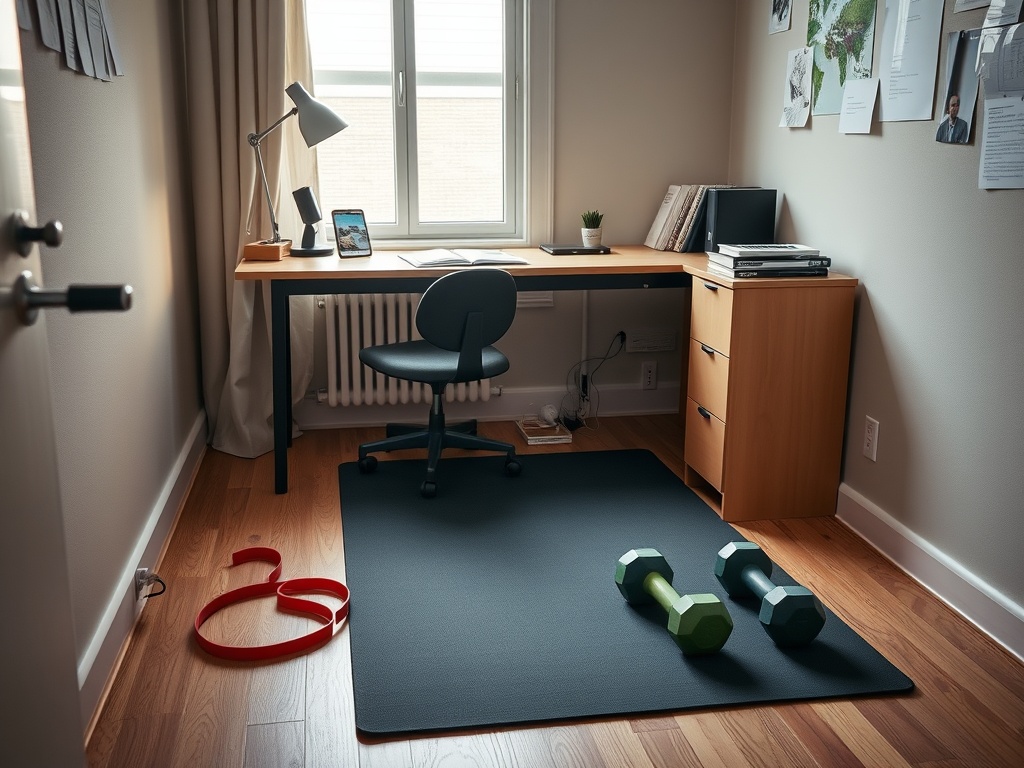
If every workout requires moving furniture, finding equipment, choosing a video, and changing clothes, the setup may be harder than the session. Keep a simple option ready. A pair of dumbbells, resistance bands, or bodyweight movements can cover basic strength patterns. Walking requires almost no setup.
For people unsure what strength tools to keep at home, the guide on barbells, dumbbells, and machines for beginners explains why equipment should match the movements and constraints rather than an idealized gym plan.
Protect transitions at the start and end of work
Remote workers often start early because the laptop is nearby and finish late because there is no commute signal. Create an artificial boundary. A ten-minute morning walk can mark the start of the day; an evening walk or workout can mark the end.
This is partly logistical and partly psychological. A transition tells your brain that one role is ending and another is beginning. You do not need perfect motivation if the routine is attached to a repeated event.
Plan for the most predictable obstacles
Meetings consume the lunch break
Move the session earlier, or split it into two short blocks. Avoid relying on the one part of the day most likely to be taken over.
Family or household demands interrupt
Choose a routine that can pause cleanly. Walking, simple circuits, and machine-based gym work are easier to resume than complex timed sessions.
You feel self-conscious exercising at home
Use a private room, headphones, or an outdoor walk. If confidence is the main barrier, the article on improving fitness from low confidence focuses on building capability through small, repeatable wins.
Work stress makes hard training feel worse
Use an easier session. Consistency includes choosing the right dose for the day, not forcing maximum effort because it is on the calendar.
Keep tracking simple enough to continue
A small weekly log can include date, session type, duration, and a one-to-five effort rating. That is usually enough to see whether activity is becoming regular. If you enjoy wearable data, use it as feedback rather than a score; the article on wearable trends and preventive health conversations explains the difference between wellness metrics and medical conclusions.
Avoid turning every step deficit into a late-night obligation. A tracking system should support decisions, not create anxiety about perfect numbers.
Use consistency metrics that reward the right behavior
Instead of asking "Did I complete every planned workout?" ask:
- Did I move on most workdays?
- Did I complete at least one or two meaningful strength sessions?
- Did I use the backup version instead of abandoning the week?
- Did I recover well enough to repeat the routine?
- Did I reduce long sedentary blocks where practical?
These questions preserve the direction of the plan even when the week is imperfect.
Scale up only after the schedule is stable
Once you can keep the routine for several weeks, add a small amount of duration, resistance, or intensity. Do not add complexity first. The exercise that fits your workday is more valuable than a sophisticated plan that repeatedly loses to your calendar.
If your job changes, travel increases, or family responsibilities shift, redesign the routine rather than trying to force the old structure into a new life.
Create a shutdown rule for work
One of the strongest remote-work tactics is deciding when work is officially over. Choose a recurring shutdown action such as writing tomorrow's first task, closing communication apps, and putting the laptop out of sight. Then attach the planned walk or workout to that boundary. This reduces the common pattern in which exercise is scheduled for 6 p.m. but work expands until 6:40 because nothing marks the transition. If your role genuinely requires variable hours, use a range rather than an exact time and keep the short routine ready. The purpose is not rigid productivity theater. It is to protect a small block of physical activity from the unlimited nature of digital work. A repeatable boundary can make exercise feel like the next part of the day instead of one more task competing with unfinished email.
Make consistency easier than motivation
Remote work makes movement easy to postpone because there is always another task within reach. Use fixed cues, a dedicated setup, and multiple versions of the routine so exercise still has a place on imperfect days. The goal is not a flawless streak; it is a system that keeps restarting itself.