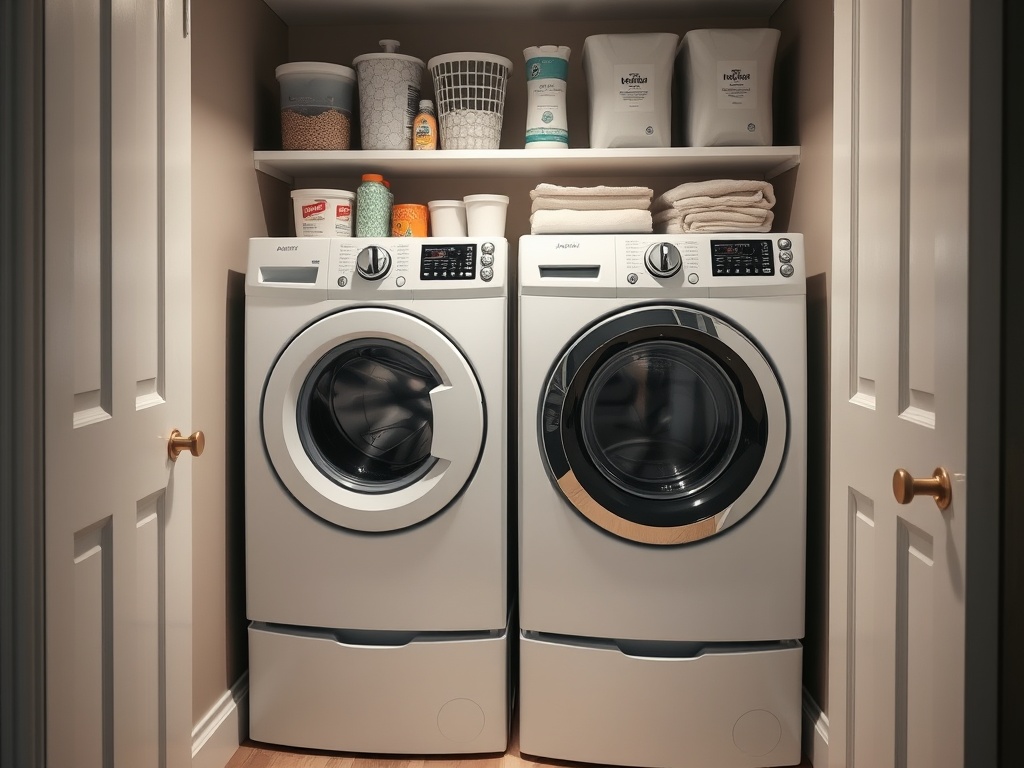
A small laundry closet gains useful capacity when you design around appliance clearances, door movement, ventilation, and the sequence of real laundry tasks. Start with the washer and dryer requirements, then use the safest remaining wall and vertical space for sorting, supplies, hanging, and folding support.
TL;DR: Measure the appliances and closet precisely, verify venting and hookups, keep required service access open, move rarely used supplies upward, put daily products within comfortable reach, add narrow sorting or hanging solutions only where they do not obstruct doors or airflow, and avoid storage that crowds heat-producing appliances or hides leaks and shutoffs.
Measure the Closet as a Working System
Measure wall-to-wall width, floor-to-ceiling height, and closet depth. Then measure each appliance, including hoses, plugs, vent connections, control-panel projection, and the space required for doors or lids to open fully. Do not assume the published appliance width tells you the total working footprint.
Mark water shutoffs, drain locations, electrical outlets, gas connections if present, dryer ducting, baseboards, trim, and door tracks. Note the direction of the closet door swing and whether bifold or sliding doors reduce access at the sides.
If the problem is part of a wider household-clutter issue, a fast weekend home reset can help separate true capacity problems from items that simply do not belong in the laundry zone.
Verify Safety and Manufacturer Clearances First
Before installing shelving, cabinetry, hooks, or countertops, read the washer and dryer installation instructions. Required clearances vary by model and installation type. Dryer venting, heat management, gas connections, electrical requirements, and access for service should take priority over additional storage.
The U.S. Fire Administration's appliance and electrical fire-safety guidance advises plugging major appliances such as washers and dryers directly into wall outlets rather than using extension cords. It also emphasizes dryer-lint and vent maintenance. Do not route storage, shelves, or hanging items where they interfere with a dryer vent or appliance cord.
If a gas appliance, new electrical circuit, plumbing relocation, vent modification, or structural work is involved, use qualified professionals and follow local codes and manufacturer requirements.
Decide What the Closet Must Hold
Capacity improves when the closet has a job description. List what genuinely needs to live there. A typical list might include detergent, stain treatment, mesh wash bags, cleaning cloths, a lint-bin container, an ironing tool, laundry baskets, and a small supply of household linens.
Keep unrelated bulk supplies elsewhere when possible so the closet remains focused on laundry tasks.
If you are solving storage constraints throughout the home, compare the laundry closet with the principles in designing around an awkward room shape. Both projects improve when circulation and fixed features are mapped before storage is added.
Build Storage Upward Without Blocking Service Access
Vertical storage is often the largest opportunity in a closet, but it should be shallow enough to reach safely and positioned so appliances can still be serviced.
A shelf above side-by-side machines can hold lightweight backstock. Adjustable wall shelving can work when the wall construction and mounting hardware support it. Closed cabinets reduce visual clutter but require clearance for doors.
Reserve the highest shelf for light, infrequently used items. Keep liquids that could leak in stable bins and avoid placing heavy containers where they must be lifted over shoulder height. Frequently used detergent and stain products are more practical at a comfortable reach level.
Add a Work Surface Only When the Appliance Setup Allows It
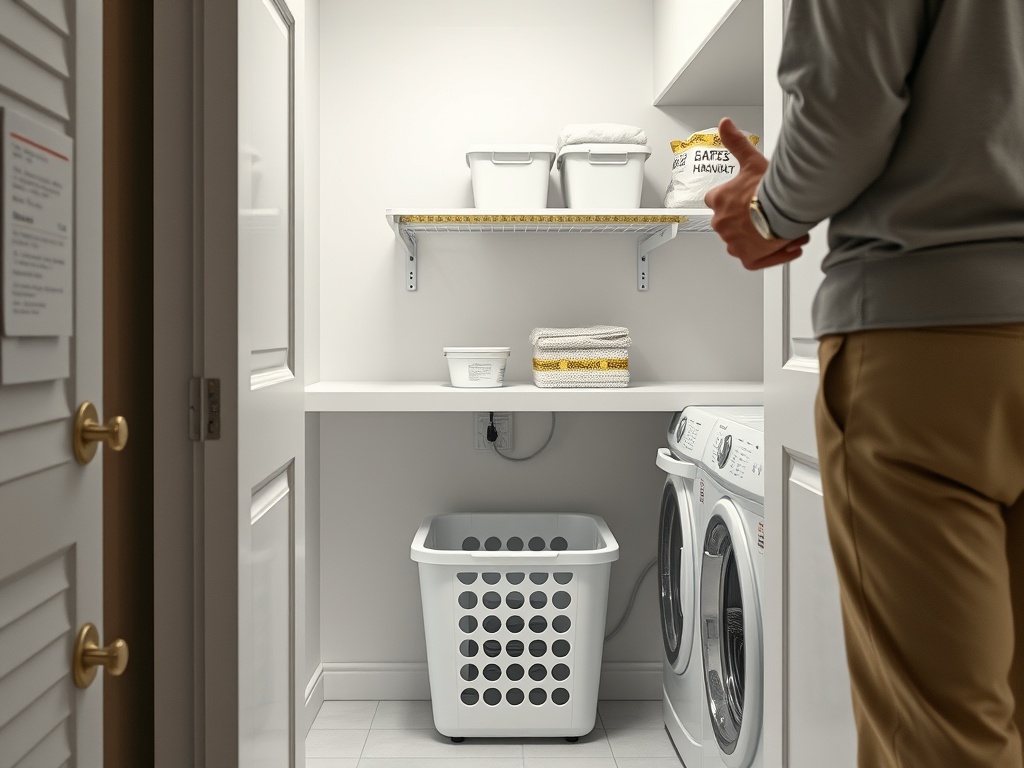
A countertop over front-loading machines can create folding space, but it is not suitable for every installation. Appliances may move slightly during operation, and service access, ventilation, controls, or manufacturer clearances may limit what can be installed above them.
A removable work surface can be easier to service than one that traps machines beneath permanent cabinetry. With stacked appliances, a nearby rolling cart may provide folding support without reducing access.
Create a Sorting System That Fits the Door Opening
Large hampers are often the first thing to block a laundry closet. Instead of choosing the highest-capacity basket, choose containers that can pass through the doorway and can be lifted when full.
A slim divided hamper can separate common categories. In very tight spaces, sorting may work better outside the closet, with only one active hamper inside. Wall-mounted bags can save floor area but must not touch hot appliances, block vents, or obstruct door hardware.
Use the Side Walls for Narrow Functions
The small strips of wall beside or behind a door can sometimes handle narrow storage that would not fit elsewhere. Options include hooks for mesh bags, a slim rail for empty hangers, a shallow rack for lint rollers, or a wall-mounted ironing-board holder if the product and wall assembly are suitable.
Do not let narrow storage become a snag point. Test the depth with cardboard before installing a permanent rack.
If the laundry closet sits near a small kitchen or multifunctional rental space, the reversible storage ideas in making a rental kitchen more functional can also inspire nonpermanent hooks, carts, and contained backstock, provided the laundry appliance clearances remain protected.
Improve Appliance Efficiency Without Adding More Storage
A redesign should make the closet easier to operate, not merely fuller. Keep the lint filter easy to reach. The U.S. Fire Administration advises cleaning the lint filter every time the dryer is used, and its basement and garage guidance recommends regular vent-duct cleaning. If shelving makes that routine harder, the shelving is working against the room.
ENERGY STAR's dryer guidance also notes that proper load size and clear airflow matter for efficient drying, while its clothes-washer guidance encourages full loads when practical. A storage redesign cannot compensate for a blocked vent, overloaded machine, or appliance that is difficult to maintain.
Keep shutoff valves, cleanouts, drain access, and leak-prone connections visible enough to inspect. A shallow tray or bin for small supplies is useful; a wall of packed boxes hiding plumbing is not.
Troubleshoot Common Laundry-Closet Problems
Shelves are deep but hard to use. Reduce shelf depth or use shallow labeled bins that can be removed as a unit. Deep storage often creates a second hidden row of forgotten products.
The closet feels packed even after adding shelves. Reduce categories. Keep one active container of each routine product in the closet and move bulk backstock elsewhere if possible.
Doors hit baskets or shelving. Change the storage footprint before changing the door. Narrower containers, a wall hook, or a rolling basket parked outside the closet may solve the conflict with less construction.
There is no folding surface. Consider whether folding truly has to happen in the closet. A nearby table, bed, or portable folding surface may be more useful than permanent worktop construction in a very tight space.
Supplies fall behind appliances. Use a shallow containment tray or shelf lip where appropriate, but do not install barriers that restrict ventilation or make the appliances difficult to pull out for service.
Finish With a Maintenance-Friendly Layout
A high-capacity laundry closet should remain easy to inspect and clean. Leave enough open access to wipe surfaces, retrieve dropped items, check hoses and vents, and reach shutoffs. Store the tools that support maintenance, such as a small vacuum attachment or cleaning cloth, where they can be reached without unloading the closet.
Before buying more organizers, live with the new layout for several laundry cycles. Notice where detergent naturally lands, where empty hangers pile up, and which container becomes an obstacle. Make the final storage decisions from actual use rather than from an idealized floor plan.
Laundry-room information is provided for general educational purposes. Appliance installation, gas work, electrical work, plumbing, venting, structural mounting, and code compliance may require qualified professionals. Always follow appliance and storage-product manufacturer instructions.[/