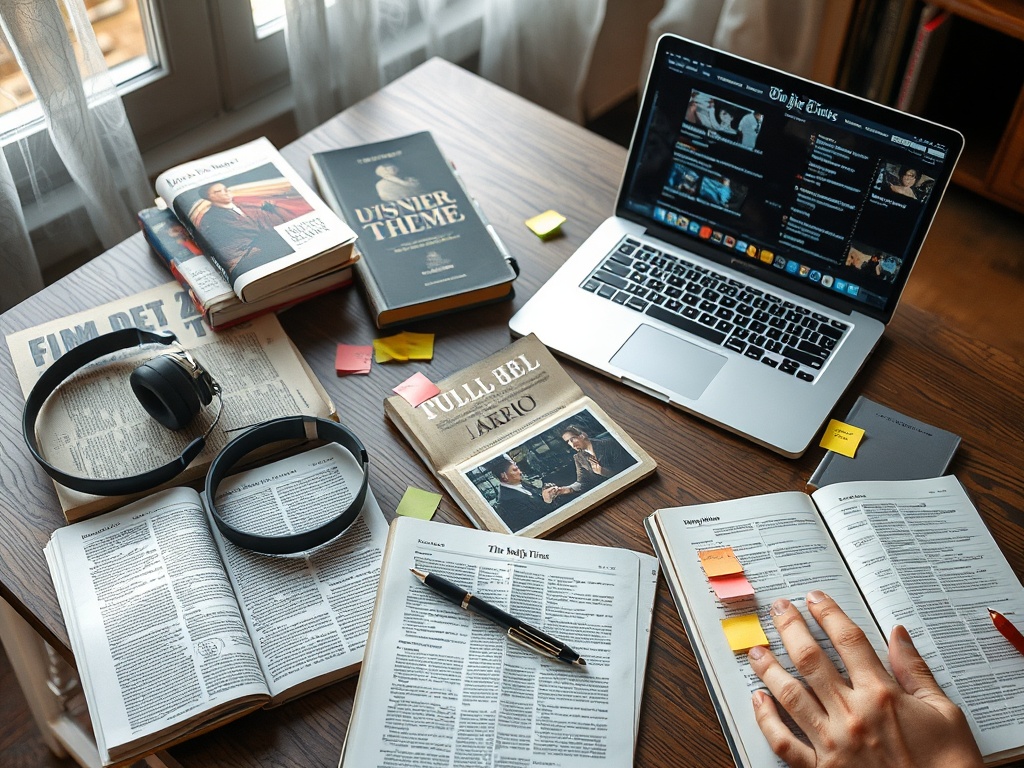
A thematic watchlist or reading list works best when it begins with one cultural question instead of a pile of titles. The question gives the list purpose, boundaries, and a way to compare works without treating every recommendation as equally relevant.
List-building method: Start with a question, choose a scope, mix primary works with context, add contrast, and leave room for revision after each viewing or reading session.
Turn curiosity into a question
A vague goal such as “learn more about film history” or “read more about pop culture” is hard to act on. A cultural question is easier: How did city life change romantic comedy? How do museums tell stories through retail objects? How does grief appear in family animation? How do concert films turn performance into memory? The question should be narrow enough to guide selection but broad enough to support comparison.
For cultural research context, the Library of Congress National Film Registry models selection around cultural, historical, or aesthetic significance, and the National Film Preservation Foundation guide explains why preservation context changes how viewers understand film history.
The Library of Congress National Film Registry is a useful model because it organizes films around cultural, historical, or aesthetic significance rather than mere popularity. The National Film Preservation Board’s preservation research also reminds readers that access, context, and preservation shape what later audiences can study. A good personal list borrows that seriousness without pretending to be an archive.
Write the question at the top of the list. If a title does not help answer it, save that title for another list. Exclusion is not snobbery. It is how a list becomes useful.
| List component | Purpose | Example role |
|---|---|---|
| Anchor work | Gives the list a central reference point. | A film, book, album, exhibition, or performance everyone in the list responds to. |
| Predecessor | Shows what came before the anchor. | Earlier genre example, source text, or historical influence. |
| Contrast work | Prevents the list from confirming only one view. | Different country, era, budget level, medium, or audience. |
| Context source | Adds criticism, history, interviews, or technical background. | Essay, catalogue, lecture, documentary, or preservation guide. |
Choose scope before choosing titles
Scope answers three questions: how many items, what time period, and which media count? A six-title weekend list should be tight. A semester-long reading and viewing list can include detours. A list about one cultural question may include films, books, essays, album liner notes, interviews, museum catalogues, and recorded performances, but only if those forms help answer the question.
A useful structure is “three by three”: three primary works, three context pieces, and three contrast pieces. For example, a question about how animated family stories handle grief could include one mainstream feature, one short film or proof-of-concept case, one critical essay, one interview, one older children’s story, one non-U.S. animation, and one work that avoids sentimentality. The point is not to finish everything. The point is to see patterns.
Readers interested in animation can connect this method to how a short film becomes a feature animation proof of concept. A short and its later feature can become a paired study: what changed, what stayed, and what the longer form made possible.
Balance enjoyment with context
A thematic list should not become homework so heavy that it kills curiosity. Start with primary works that are compelling on their own, then add context where it improves perception. A preservation guide, critic essay, catalogue entry, or artist interview should help you see the work more clearly. If a source only adds jargon, replace it.

The National Film Preservation Foundation’s guide to film preservation is an example of a context source that changes how a viewer thinks about access and survival. It may not tell you which film to like, but it can make you notice how fragile film history can be. That kind of context turns a watchlist into a cultural inquiry.
Write notes as comparisons, not summaries
After each item, write three quick notes: what answered the question, what complicated the question, and what should come next. Avoid plot summaries unless details are needed for comparison. The value of the list is the conversation between works. If every note is isolated, the list becomes consumption tracking instead of thinking.
For a list about fandom surprise, one entry might connect to how a surprise cameo rewires an entire fandom conversation. The note should not only say who appeared. It should ask how recognition changed the audience’s interpretation, what prior knowledge was required, and whether the moment deepened or distracted from the story.
Use gaps as part of the method
Every list has blind spots. Instead of hiding them, mark them. Which countries are missing? Which decades dominate? Are you reading mostly critics from one background? Are you choosing works that confirm your taste? A strong thematic list improves as it admits what it cannot cover yet.
This is also where museums offer a useful analogy. A museum store feels educational when its assortment makes a curatorial argument; a museum store assortment that feels educational instead of random uses selection and context to guide the visitor. A watchlist does the same. It teaches by ordering attention.
A closing practice for better lists
End each list with a short reflection: “My answer to the question changed because…” Then write the next question. The goal is not to finish culture. The goal is to build a habit of looking, reading, and comparing with purpose. One good question can turn scattered recommendations into a map of how works speak to each other.
A revision habit after the first pass
After finishing the first version of the list, remove one obvious title and add one uncomfortable contrast. The obvious title may still be useful, but removing it tests whether the list has become too dependent on reputation. The contrast title pushes the question into less familiar territory.
Then write a short note about what the list excludes on purpose. Maybe it avoids biopics, limits itself to one decade, or focuses on public institutions rather than commercial entertainment. Naming the boundary makes the list more honest and easier to revise later.
Finally, give the list a title that states the question rather than the genre. “Five films about cities” is less useful than “How do films make loneliness visible in crowded cities?” The better title keeps the inquiry alive every time you add or remove a work.
That title can also keep recommendations from friends on track. When someone suggests a title, ask how it answers the question. If they cannot say, it may belong on a future list instead of this one.